What’s My Home Worth?

Blog
CONTACT
Winning Edge Real Estate
License #: 94690
License #: 268528
5405 Twin Knolls Rd, Unit 1, Columbia, Md 21045
Home Prices in Early 2026: Are They Going Up, Down, or Staying Flat?
The Biggest Question in Real Estate Right Now
If you’re thinking about buying, selling, or investing in real estate in 2026, one question is probably front and center in your mind: What are home prices actually doing right now?
It’s a fair question—and one that doesn’t have a simple, one-size-fits-all answer. The headlines can be confusing. One day you read that prices hit a record high. The next, you hear about markets where prices are falling. So what’s actually happening?
Here at Winning Edge Real Estate, Realtors Grant Bim, Weston Bim, and Jim Bim have been tracking the data closely. In our January 2026 Real Estate Market Update video, we broke down the real numbers—and in this blog, we’re going even deeper. We’ll walk you through the national picture, the regional differences, what’s driving prices, and most importantly—what it all means for your next move.
Let’s dig into the data.
The National Picture: Modest Growth, Not a Moonshot
Here’s what the numbers tell us heading into 2026: home prices are still rising nationally, but the pace has slowed dramatically compared to the pandemic-era frenzy.
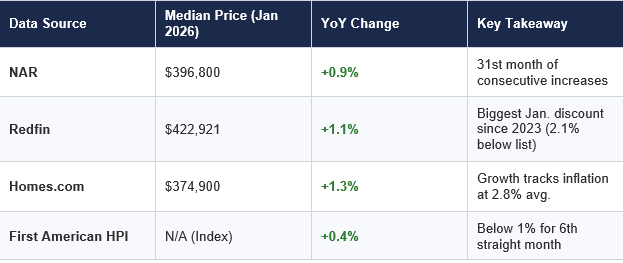
According to the National Association of Realtors (NAR), the median existing-home sale price in January 2026 was $396,800, representing a 0.9% increase from January 2025. That marks the 31st consecutive month of year-over-year price increases—but it’s one of the slimmest gains we’ve seen in this streak.
Meanwhile, Redfin’s data pegs the median sale price slightly higher at $422,921, showing a 1.1% year-over-year gain in January. First American’s Home Price Index confirms the same trend—national appreciation has remained below 1% for six straight months.
Homes.com reported the nationwide median sale price grew from $370,000 in January 2025 to $374,900 in January 2026, with home price growth averaging 2.8% per year over the past two years—almost identical to overall inflation.
What Does This Mean in Plain English?
Home prices are not crashing. They’re not skyrocketing either. We’re in a period of stabilization—which, for a market that saw double-digit annual price jumps during the pandemic, is actually a healthy sign. Think of it as the market catching its breath.
The Regional Story: A Tale of Two Markets
While the national numbers paint a picture of modest, steady growth, the real story in 2026 is the dramatic regional divergence. Where you live—or where you’re looking to buy—matters enormously.
Markets Where Prices Are Rising Fastest
The Northeast and Midwest are leading the nation in home price appreciation. According to multiple data sources, these regions are experiencing strong demand driven by tight inventory and relative affordability compared to coastal markets.
•+10.8% year-over-year (Redfin)Milwaukee, WI:
•+8.6% to +10% depending on data sourcePhiladelphia, PA:
•+8.4% year-over-yearCleveland, OH:
•+5.6% year-over-yearBaltimore, MD:
•+4.8% year-over-yearWashington, D.C.:
•All above +5% year-over-yearDetroit, Columbus, Cincinnati:
Why? These markets have seen very limited new housing construction, keeping supply extremely tight. Many also offer median home prices well below national averages, attracting buyers who are priced out of higher-cost coastal cities.
Markets Where Prices Are Declining
The other side of the coin tells a very different story. Parts of the West Coast and Sun Belt—regions that saw massive price surges during the pandemic—are now experiencing price softening or outright declines.
•-5.6% year-over-yearSan Jose, CA:
•-3.6% year-over-yearPortland, OR:
•-4.3% year-over-yearRaleigh, NC:
•-3.8% year-over-yearSeattle, WA:
•-2.7% year-over-yearFort Lauderdale, FL:
•All recording annual declinesOakland, Denver, Las Vegas, Los Angeles:
What’s driving the softness? A combination of pandemic-era overbuilding, slowing domestic migration to these regions, rising insurance and property tax costs (especially in Florida and Texas), and more inventory giving buyers negotiating power.
The Bottom Line on Regional Trends
As Cotality’s Chief Economist noted: “Looking ahead to 2026, regional differences will remain pronounced, with demand favoring areas that offer both economic opportunity and relative affordability.”
This is exactly why working with a local real estate expert who understands your specific market is more important than ever. National headlines don’t tell your neighborhood’s story.
What’s Driving Home Prices in 2026?
Understanding where prices are going requires understanding the forces behind them. Here are the five biggest factors shaping home prices right now:
1. Inventory Is Growing—But Still Below Normal
Housing inventory is up approximately 10% year-over-year nationally, according to HousingWire data. That’s a meaningful increase and a relief from the extreme shortages of 2021–2023. However, active listings remain roughly 17.8% below pre-pandemic 2019 levels nationally, meaning we haven’t fully recovered from the supply crunch.
NAR reported 1.22 million units of total housing inventory in January 2026, representing a 3.7-month supply. A balanced market is typically considered to be 5–6 months. So while we’re moving toward balance, we’re not there yet in most markets.
2. Mortgage Rates Are Stabilizing Around 6%
The average 30-year fixed mortgage rate fell to approximately 6.1% in January—the lowest level since 2022. While still more than double pandemic-era lows, this represents meaningful improvement. Forecasts from J.P. Morgan and Realtor.com project rates averaging around 6.3% for the full year of 2026.
Rates directly impact how much home buyers can afford, and modestly lower rates are providing some relief—helping to support demand without triggering the kind of buying frenzy that would push prices sharply higher.
3. Income Growth Is Outpacing Price Growth
This is one of the most encouraging developments in the 2026 housing market. Wages grew 3.7% year-over-year in January—more than triple the pace of home price growth. NAR’s Housing Affordability Index reached 116.5 in January, the highest reading since March 2022. Affordability is improving for the seventh consecutive month.
What this means: even though prices are still at record highs in dollar terms, the relationship between incomes and housing costs is slowly healing. This is what healthy, sustainable markets look like.
4. Buyers Have More Negotiating Power
Redfin data shows that the typical home sold in January went for 2.1% below its final list price—the biggest January discount since 2023. Only 20.8% of homes sold above list price, the lowest January share since 2020. Homes are spending a median of 46–66 days on market depending on the data source, the slowest January pace in a decade.
Buyers in 2026 have more options, more time, and more leverage than they’ve had in years. This shift in negotiating dynamics is keeping a natural ceiling on prices.
5. The Lock-In Effect Is Gradually Easing
Millions of homeowners locked in mortgage rates below 4% during the pandemic and have been reluctant to sell and take on a higher rate. This “lock-in effect” constrained supply for years. While it hasn’t disappeared, life events—job changes, divorces, growing families, downsizing—are gradually loosening the grip, with new listing activity ticking up in early 2026.
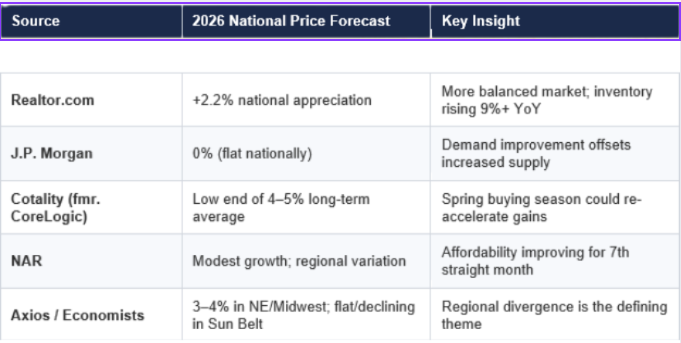
The consensus: expect modest, single-digit national appreciation in 2026, with the real story playing out at the regional and local level. A crash is not in the cards, but neither is a return to double-digit gains.
What This Means If You’re a Buyer
If you’re thinking about buying a home in 2026, the price environment is actually more favorable than it has been in years. Here’s why:
•Homes are selling below list price more often, and you have more time to make decisions.More negotiating power.
•Wages are growing faster than prices, and rates have come down from their peaks.Improving affordability.
•You’re not competing against 15 other offers like you were in 2021–2022.More inventory.
•If prices grow even modestly (2–3%) this year while you wait, and rates don’t drop significantly, waiting could cost you more in the long run.Strategic opportunity.
Our advice: Don’t try to time the market perfectly. Focus on finding the right home at a payment you can afford. If rates drop later, you can refinance. But if prices rise while you wait, you can’t un-buy the appreciation you missed.
What This Means If You’re a Seller
If you’re thinking about selling in 2026, the days of slapping any price on your home and getting multiple offers above asking are over in most markets. That said, this is still a solid time to sell—if you approach it with the right strategy.
•Overpriced homes are sitting longer and taking price cuts. One-third of all listings are reducing their price before selling.Price it right from day one.
•NAR reports that a typical homeowner has accumulated $130,500 in housing wealth since January 2020. That’s a powerful financial position.Your equity is real.
•With buyers having more choices, professional photography, staging, and marketing are no longer optional—they’re essential.Presentation matters more than ever.
•Seasonal patterns are normalizing. The spring buying season is expected to bring increased buyer activity, so timing your listing for maximum exposure matters.Spring is coming.
Our advice: Work with a local expert who understands your specific market’s pricing dynamics. A well-priced, well-marketed home will still sell. An overpriced one will sit—and every day on market costs you leverage.
What This Means If You’re an Investor
For real estate investors, 2026’s price environment creates both challenges and opportunities:
•still offer strong appreciation potential with entry prices well below national medians.Value markets in the Midwest and Northeast
•may create buying opportunities in markets like Austin, Raleigh, and Phoenix where prices are correcting from pandemic highs.Sun Belt softening
•are creating an unusual dynamic where new homes can actually be cheaper than resale homes—something that’s only happened a few times in recent decades.Builder incentives
•need to account for rising insurance costs, especially in Florida and Texas, and property tax adjustments. Cash flow calculations
Are Home Prices Going to Crash? Let’s Address the Elephant in the Room
Every time the market shifts, the crash predictions come flooding in. So let’s be direct: the fundamentals do not support a national housing crash in 2026. Here’s why:
•We’d need significantly more inventory to trigger broad-based price declines.Supply is still below historical norms.
•Today’s borrowers are far more qualified than those in the 2006–2008 era. We’re not sitting on a mountain of bad loans.Mortgage quality is strong.
•Forced selling, which drives crashes, isn’t happening at scale.Homeowner equity is at record levels.
•Millennials and Gen Z represent millions of potential buyers who need housing.Demographic demand is real.
Could specific local markets see price declines of 5–10%? Absolutely—and some already are. But a national crash like 2008? The data simply doesn’t support that scenario.
The Bottom Line: Knowledge Is Your Greatest Asset
Home prices in early 2026 are telling a nuanced story. Nationally, we’re seeing modest appreciation in the range of 0–2%. Regionally, the Midwest and Northeast are outperforming while parts of the West Coast and Sun Belt are softening. Inventory is growing but still below normal. Affordability is slowly improving. And buyers have more negotiating power than they’ve had in half a decade.
Whether you’re buying, selling, or investing, the smartest thing you can do is make decisions based on data and local expertise—not national headlines or social media hot takes.
Ready to Make Your Next Move?
Realtors Grant Bim, Weston Bim, and Jim Bim with Winning Edge Real Estate are here to help you navigate the 2026 market with confidence. Whether you’re buying your first home, selling for maximum value, or exploring investment opportunities—we’ve got the local expertise and data-driven approach to help you win.

WORK WITH WINNING EDGE
We Are All Here to Help You Accomplish All of Your Real Estate Goals.




Disclaimer: All information contained on this website is deemed reliable but not guaranteed. All properties are subject to prior sale, change or withdrawal notice gowinningedge.com believes all information to be correct but assumes no legal responsibility for accuracy.