
Columbia, MD, is not a town that happened. It was designed - deliberately, philosophically, from the ground up. That distinction matters more than most buyers realize when they start looking at homes here and weighing the pros and cons of living in Columbia, MD. The median sale price sits at roughly $510,000, and properties are averaging about 22 days on market, which tells you something about demand. But the numbers only make sense once you understand what this place actually is and how it came to be.
The layout, the amenities, the village structure, the way the neighborhoods feel - none of it is accidental. It all traces back to a master plan and the man who drew it up.
Early Planning and the Founding of Columbia
Columbia, Maryland, was officially founded on June 21, 1967. The person behind it was James W. Rouse, a real estate developer and urban planner from Easton, Maryland, and he came into this project with a genuinely different set of priorities than most developers of his era.
This wasn't standard mid-century suburban sprawl. Rouse was trying to build something that solved problems most developers were perfectly happy to ignore.
The Vision Behind the Master Plan
The central goal was to create a community that would avoid racial, religious, and class segregation - built into the design itself, not left to chance. That meant integrating different housing types and community facilities from the start, across the entire layout.
That foundational thinking still shapes what you see in the market today. With about 164 homes currently in active inventory, the original neighborhood structures Rouse laid out are very much still organizing residential life here.
Where Columbia Sits in Maryland
Columbia is in Howard County, and it's a significant part of the Baltimore–Columbia–Towson, MD Metropolitan Statistical Area. Geographically, that puts it squarely between two major East Coast economic centers - which is not a coincidence.
Pull back even further and it's also included in the larger Washington–Baltimore Combined Statistical Area. For buyers thinking about commutes or employment options, that positioning is worth understanding before you start touring homes.
Understanding the Community Structure
People ask me all the time whether Columbia is a city, a town, or just a neighborhood. The honest answer is that it functions at city scale in terms of economic output, but it's structured as a planned community made up of distinct villages and neighborhoods.
It's also unincorporated, which means local governance and community maintenance work differently than they would in a traditional municipality. The Columbia Association handles the shared amenities, the archives, and the recreational facilities that serve residents - and that distinction has real implications for how you'll experience ownership here.
Historic Landmarks and Local Archives
The Columbia Association operates the Columbia Archives, which is the primary resource on the area's planning history and early development. If you want to understand how this community came together, that's where the documentation lives.
The land itself is older than the plan, though. Older structures were part of the territory when Rouse's development began, and preserving them was part of how the area's past got woven into its modern form.
The Woodlawn Historic House
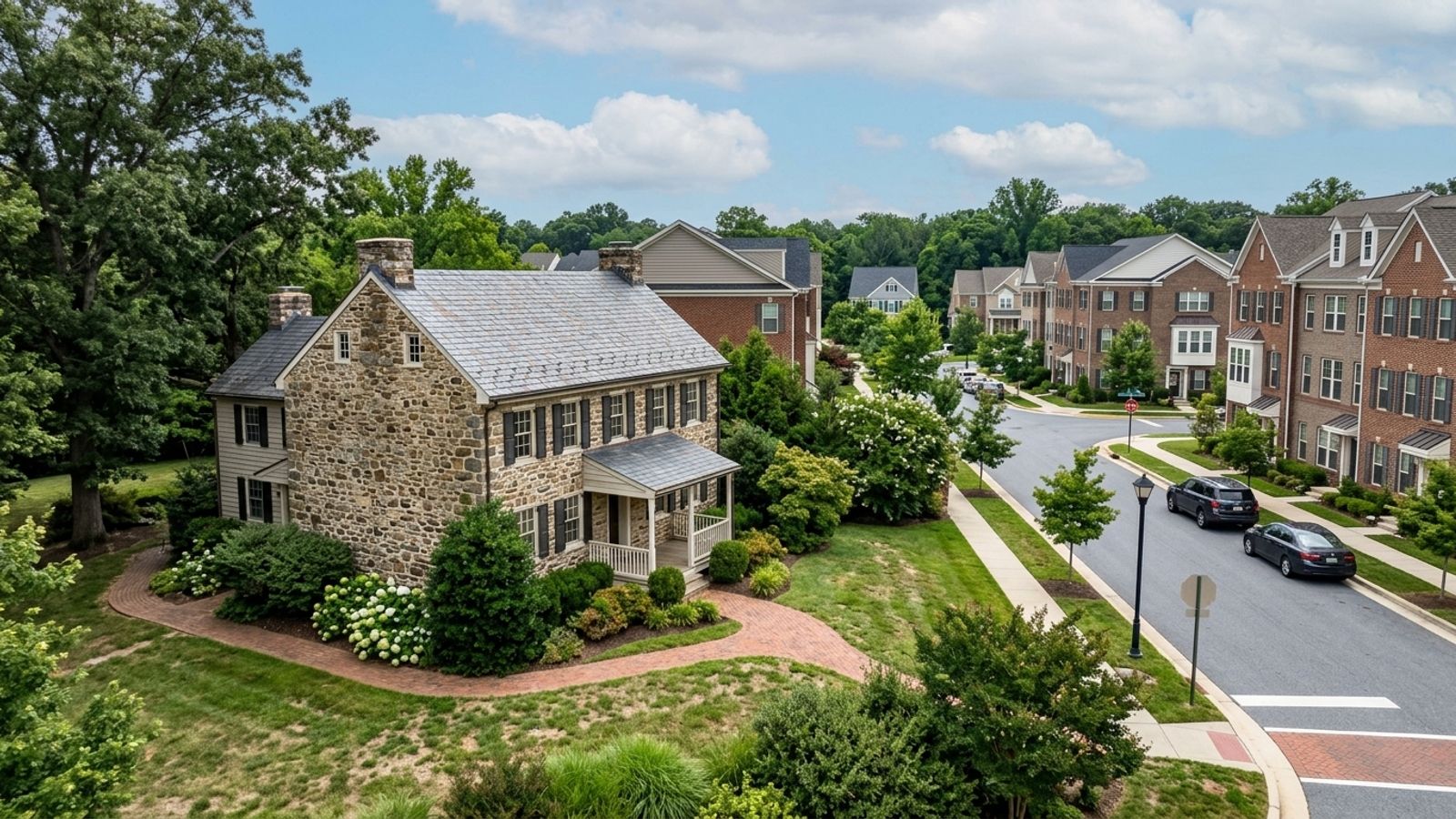
The most significant surviving example is Woodlawn - a historic slave plantation house at 9254 Bendix Rd. in Columbia. The two-story stone house was built in 1840, though earlier wood-frame portions of the property date back to approximately 1785. It was added to the U.S. National Register of Historic Places on February 3, 1983.
Standing next to the modern commercial and residential buildings that now surround it, Woodlawn is a stark reminder of Howard County's agricultural history. It's the kind of thing you drive past and don't immediately expect.
What Drives the Local Economy Today
Based on 2024 data, the economy here runs on professional, scientific, and technical services, along with health care, social assistance, and educational services. Those are the sectors anchoring employment in the area.
Manufacturing and insurance also carry real weight in the local economy. The presence of major employers with large operational hubs here is a significant part of why housing demand stays steady - and why homes regularly sell slightly above their list price.
Major Employers and Corporate Presence
Maxim Healthcare Services is one of the most prominent companies headquartered in the area. That kind of corporate concentration matters for the housing market because it reduces the pressure on residents to commute to Baltimore or Washington for work.
The result is a tight market. With only about 1.4 months of housing supply currently available, the steady stream of professionals looking to live near their employers keeps inventory from loosening up much.
Frequently Asked Questions
How did Jim Rouse's original vision shape the village and neighborhood layout of Columbia, MD?
James W. Rouse designed the community specifically to avoid the problems of typical subdivision development, including racial, religious, and class segregation. The layout integrates diverse housing types and shared amenities across distinct villages. That master plan is still defining the area's residential structure today.
Why do Columbia homeowners pay an annual CPRA fee, and how is it tied to the community's founding?
The fees support the Columbia Association, which runs resources like the Columbia Archives and manages shared spaces. That funding structure was built into the original plan - it was how James W. Rouse intended to ensure the recreational amenities he envisioned would actually be maintained over time.
In what order were the villages of Columbia built, and how does that dictate the age of homes in different areas?
The villages were built in phases after the June 21, 1967 founding. Homes in the earliest villages reflect late-1960s and 1970s architecture; later phases bring progressively newer construction. Which village you're shopping in tells you a lot about what era of home you're looking at.
Are all homes with a Columbia address part of the original 1967 Columbia Association master plan?
No. Some properties predate the planned community entirely - the 1840 Woodlawn stone house on Bendix Road is the clearest example of that.
What are the architectural restrictions for renovating older homes built during Columbia's early development phases?
Homes within the planned community fall under the Columbia Association's oversight. Before you plan any exterior work, you'll want to review the association's guidelines - they exist to maintain a cohesive look across the community, and they apply to renovations.
How does buying property in a planned community like Columbia compare to older, organically developed Maryland towns?
In a planned community you're agreeing to centralized association rules, and in return you get integrated amenities and a deliberately structured environment. Columbia was intentionally designed by James W. Rouse to avoid typical subdivision sprawl - that's the core difference from a town that just grew on its own.
FROM OUR BLOG
Selling a Home with a Probate Real Estate Agent in Columbia, MD
The median home sale price in Columbia, MD is currently around $510,000, and available homes spend roughly 25 days on the market before going under contract. For those buying a home in Columbia, MD, the market moves quickly. For executors and administrators managing an estate, those fast-moving mark
Best Real Estate Agent for Estate Sales in Ellicott City, MD: Jim Bim
Jim Bim has closed over 5,000 career transactions as the Broker and Owner of Winning Edge Real Estate. Finding the right agent for an estate sale in Ellicott City, MD comes down to what the executors and heirs need - someone who understands timelines, can handle the logistics, and knows how to price
Choosing Between an Estate vs Trust in Ellicott City, MD
The median sale price for a home in Ellicott City, MD recently hit roughly $761,000. For most homeowners, that's the single largest financial asset they'll ever own - and figuring out how to pass it on to the next generation means choosing a legal path before you need one. If your family is ever tas
Welcome to Winning Edge Real Estate a Family Owned and Operated Real Estate Brokerage where Winning Matters. We serve all of your real estate needs in and around the Baltimore / Washington Corridor. The Company is run by Jim Bim, Broker of Record, his son's Grant Bim and Weston Bim are Sales people within the company. Jim, Grant and Weston work to help their Sellers & Buyers accomplish their real estate goals while the Office Manager, Valerie Bim, and our Assistant, Kimberly make sure that homes go from "FOR SALE" to "SOLD" smoothly while making sure to keep you informed every step of the way. As real estate specialists we are experts in representing both home Sellers and home Buyers. We can help with general residential home / town home / condo resale, new homes, custom home construction, land sale, sub dividing acreage, as well as investment property. We are very knowledgeable of Howard County, Maryland as we have lived in the area for 40+ years. Due to our clients moving throughout the state, we also are very knowledgeable of Anne Arundel County, Carroll County, Frederick County, Baltimore County and Montgomery County. We actively work on a daily basis in areas that include: Fulton, Ellicott City, Columbia, Mount Airy, Clarksville, Woodstock, Jessup, Marriottsville, Glenelg, Glenwood, West Friendship, and everywhere in between. We also service Western Baltimore County which includes Arbutus, Halethorpe, Catonsville, Owings Mills and Reisterstown. We provide a free Maryland Real Estate search where we feature Howard County, Carroll County, Baltimore County, and Anne Arundel County real estate that will allow you to find homes, condos, townhomes, new homes, luxury homes, or even acreage, lots, or investment properties. Do you want to invest for your future, but you are not sure how to make the leap to become a real estate investor? We can help you find the right money making property, rent your property, and manage your property. If you have the desire to be a real estate investor, then we have the knowledge and know how to get you to real estate investor success. Quick Stats/Highlights: 100% of asking price (average) 63+ active listings Serving: 8 Maryland counties Hundreds of 5-star reviews