
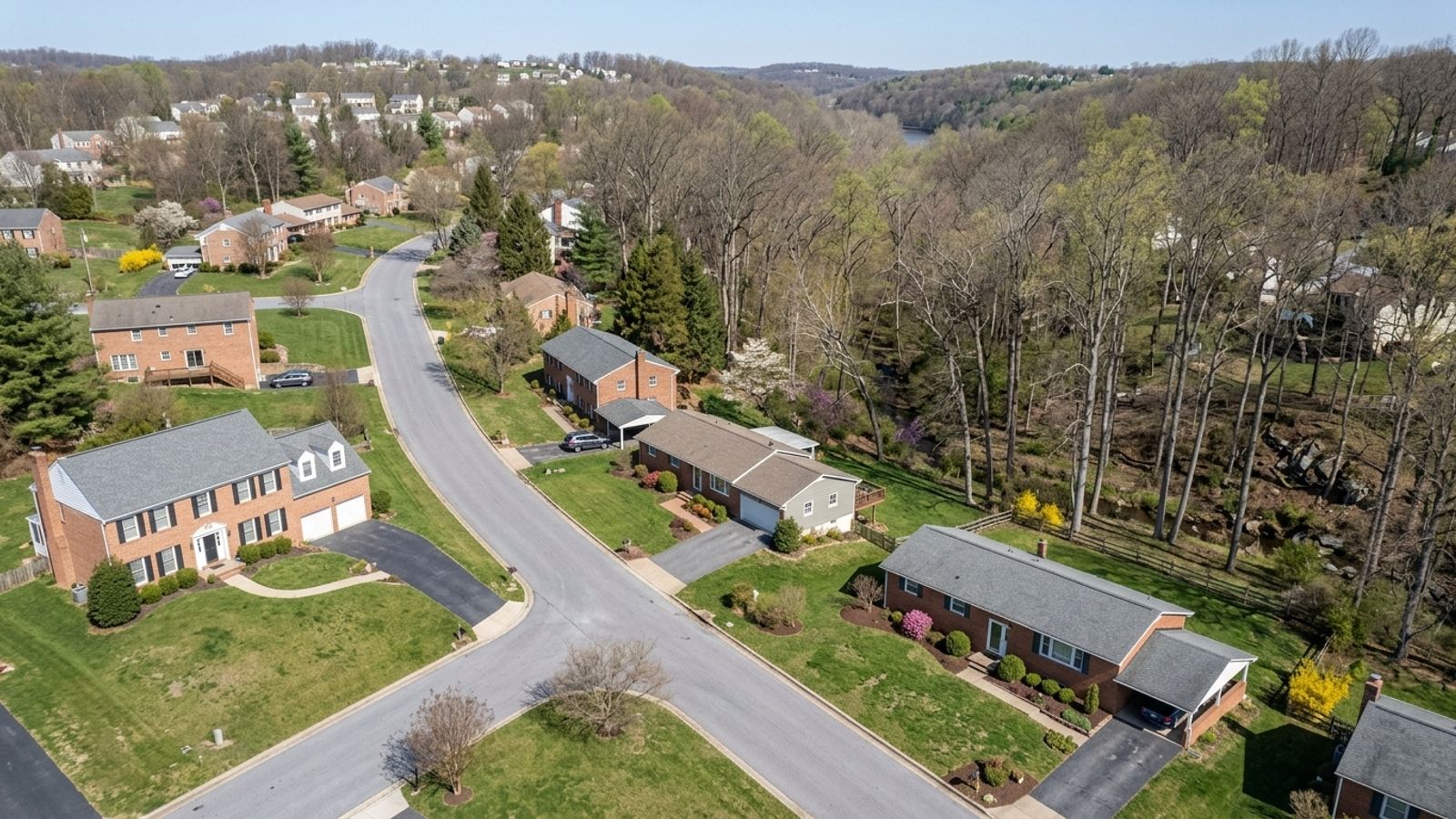
The weather pattern that should shape an Ellicott City home search isn't the temperature curve forecast sites show. It comes down to short, intense summer downpours that this steep river-valley town funnels into flash floods. Average temperatures dictate your utility bills, but sudden precipitation dictates your property's safety and maintenance needs.
With single-family homes sitting at about one month of supply based on recent data, you need to get a property's flood and drainage answers before you tour. Condos leave more time for that homework and hand exterior weather upkeep to the homeowner's association, but they make up a much smaller share of the market.
Key Takeaway
Ellicott City has a humid four-season climate, but the weather pattern that matters most when you buy is intense summer rain that the town's steep valley turns into flash floods. Check a property's flood zone and drainage before you tour. That homework has to come first because single-family homes sold in a median 21 days during the 90 days ending September 30, 2026. If you want more time and less exterior upkeep, condos move more slowly.
Who This Guide Is For
You are weighing a move to Ellicott City and want to know what the weather is like year-round and how it should affect which home and location you choose.
Ellicott City's Year-Round Weather Patterns
Average temperatures only tell part of the story when you buy a house here. The town's location along the Patapsco River creates specific microclimates and drainage patterns that no county-wide forecast is going to capture. The steep elevation changes in town mean weather impacts vary street by street, so you have to look at both the sky and the ground to understand what you're buying into.
A Humid Four-Season Climate
Howard County falls within a humid subtropical climate zone. Maryland's eastern half, including the Baltimore and Washington area, experiences hot, humid summers and cool to cold winters. Rain arrives in every month rather than in a distinct dry season, which makes moisture control a year-round job. There is no stretch of the calendar when you can assume a basement or yard will stay completely dry.
How the Patapsco Valley Shapes Local Weather
Ellicott City sits on steep slopes above the Patapsco River, with small streams running down toward the historic district. Elevation changes over short distances mean heavy rain on higher ground drains fast toward low points. Several streams converge on historic Main Street before reaching the Patapsco, so rain that falls well uphill often ends up in the old town.
The steep streets and driveways that make the town scenic also shed water fast in summer and ice over in winter. That matters when you look at a listing photo.
What to Expect from Ellicott City Weather by Season
Each season brings different maintenance tasks. A house shown in October will look very different than the same property after a heavy spring rain, so ask about year-round conditions regardless of when you visit.
Summer in Ellicott City
Summers bring hot, humid stretches broken up by afternoon thunderstorms, and central air conditioning is a necessary system to check during your inspection. Those thunderstorms are short but can drop several inches of rain quickly. That specific pattern, sudden and heavy, is what causes the town's worst flooding.
Fall in Ellicott City
Fall is usually the most comfortable season, with lower humidity and mild days. It's a practical time to inspect gutters, roofs, and grading before winter sets in. Atlantic hurricane season runs through November, though, and remnants of tropical systems can bring heavy multi-day rain. Leaf-clogged gutters make those fall rainstorms much harder on a home's drainage system.
Winter in Ellicott City
Winters are cold, typically delivering a mix of snow, sleet, and freezing rain rather than steady deep snow. January and February are generally the coldest months, with the normal February low sitting around 26.9 degrees. Frequent freeze-thaw cycles cause ice dams on roofs and turn steep driveways slick. Hills that look scenic in a listing photo can be hard to drive up in January.
Spring in Ellicott City
Spring brings warming temperatures, frequent rain, and heavy pollen. Touring homes during spring showers gives you the best chance to see exactly how a yard drains and whether a basement stays dry. A home shown during a dry spell can hide water problems that only appear after a soaking rain, so you have to actively ask about water history whatever the season, rather than trusting a dry basement on a sunny day.
Flash Flooding in Ellicott City
Flooding is the defining weather hazard in this part of Howard County, and the risk is very localized. A few blocks can make the difference between high ground and a flood zone. Before you make an offer anywhere in town, you need to understand the recent history.
The 1972, 2016 and 2018 Floods
In June 1972, Hurricane Agnes swelled the Patapsco River, overflowing its banks by 14.5 feet and flooding the lower end of Main Street from the bottom up. More recently, Main Street flooded twice in under two years from intense local rain. The National Weather Service reported that the May 2018 event produced observed totals of about 8.40 inches of rain in Ellicott City. Both modern floods came from rain events lasting hours instead of days, leaving little warning time.
Where Flood Risk Is Concentrated
Risk is highest along the Patapsco floodplain and the stream channels feeding historic Main Street. Most of the town is suburban and sits away from these channels, but local drainage still varies street by street. Howard County's current effective FEMA flood maps date to 2013, with an update expected to become effective around September 2027. FEMA maps show mapped hazard areas, not every place water collects, so a home outside a mapped zone can still have drainage problems.
Flood Mitigation Projects in Ellicott City
Howard County is actively working on flood mitigation projects, including the North Tunnel. This 18-foot diameter, roughly one-mile-long tunnel is designed to divert floodwater from Main Street into the Patapsco River. According to the county's official project update, the tunnel is expected to be substantially completed by fall 2027.
Mitigation reduces risk. It doesn't eliminate it, and construction schedules often shift.
How Home Types Affect Your Weather Upkeep
Different property types shift the burden of weather maintenance between you and a homeowner's association, and the speed of the local market also varies by property type. Both factors shape how much time you'll have to complete your weather-related homework before committing.
Single-Family Homes
Detached homes put roof, gutters, grading, sump pump, and snow clearing entirely on your shoulders. They're also the most competitive segment, with 57.9% of single-family homes selling above asking price in the 90 days ending September 30, 2026. You'll want your flood map check, insurance quote, and inspector lined up before you start shopping. Competition pushes buyers to shorten or waive inspections, which is exactly when hidden drainage or water problems get missed.
Townhouses
Shared walls and often HOA-handled common areas split weather upkeep between you and the association. Townhouse median prices rose just 0.4% year over year recently, which can mean less bidding pressure than detached homes. That said, who pays for roofs, siding, and drainage varies by community, so reading the HOA documents carefully isn't optional.
Condos
The HOA typically handles the exterior, roof, and grounds maintenance for condo owners. Condos also sell more slowly, sitting on the market for a median 35 days with 2.4 months of supply, based on 27 recent sales. That slower pace gives you time to research a building's weather exposure and HOA reserves before you commit. Ground-floor and garage-level units carry the most water exposure, and storm damage to shared structures can lead to special assessments.
Weather Checks to Make Before You Offer
Rain and drainage issues are very localized here, so evaluate a property's water risk before you write a contract. Waiting until after ratification limits your options if you find a problem. Each of these checks helps clarify the home's true cost of ownership.
Look Up the FEMA Flood Zone
Search the exact address on the FEMA Flood Map Service Center before scheduling a tour. If the property sits in a special flood hazard area, your mortgage lender will require you to carry flood insurance. Check Howard County's current flood mitigation project page for work scheduled near the address as well. Maps can be years old and don't capture every local drainage problem, so treat them as a starting point, not a final answer.
Read the Seller's Disclosure on Water History
Maryland requires sellers to provide either a Residential Property Disclaimer Statement or a Residential Property Disclosure Statement. Ask the seller or listing agent for any flood, water intrusion, or insurance claim history on the property. If you're buying a probate or estate home, you'll likely receive a disclaimer statement, which means the seller isn't describing the home's condition and your own inspection carries much more weight.
Get a Flood Insurance Quote Early
Standard homeowners policies generally exclude flood damage. Get a flood insurance quote for the specific address before you make an offer, not at closing. A high premium can change what you can afford monthly, and you want to know that before you bid.
Have the Drainage, Roof and Sump Pump Inspected
Ask the home inspector to evaluate the grading, downspouts, and basement moisture, and have them check the sump pump, including any backup power, and the roof's condition for ice-dam risk. The inspection window is short in a fast market. Book an inspector you trust before you start making offers so they're available when you need them.
Check the Heating and Cooling Systems
Because both summer humidity and winter cold are real factors here, confirm the age and service history of the HVAC system, and check whether the basement has a working dehumidification system. Ask for HVAC age and service records directly. An older system may work fine during a mild-weather showing but still be near the end of its life.
Deciding If Ellicott City's Weather Fits Your Search
Ask yourself these questions to narrow your focus.
If you'd like help checking a specific address's flood history before you tour, reach out to Winning Edge Real Estate.
- Is the property in or near a FEMA flood zone, a stream valley, or the historic Main Street corridor? If yes or you are not sure, review the flooding sections above and start by looking up the FEMA flood zone before booking a tour.
- Do you want to own the roof, gutters, grading, sump pump, and snow clearing yourself? If not, compare townhouses and condos to see how an HOA can help.
- How quickly can you make an offer once you find a home? If you need time for inspections and insurance quotes, review the pace gap between single-family homes and condos in the data below.
- Are hot, humid summers or icy hills a dealbreaker? Review the summer and winter sections before you narrow your search.
For non-weather factors, compare the pros and cons of living in Ellicott City. You can also explore the home buying process in Ellicott City to plan your next steps.
Ellicott City Housing at a Glance
- All homes: median sale price $747,179, up 4.1% year over year; median 26 days on market; 102% sale-to-list; 1.3 months of supply (247 sales, 90 days ending 2026-09-30)
- Single-family homes: median sale price $845,163, up 7.7% year over year; median 21 days on market; 102.5% sale-to-list; 57.9% sold above list; 1 month of supply (154 sales, 90 days ending 2026-09-30)
- Townhouses: median sale price $649,908, up 0.4% year over year; median 33 days on market; 101.9% sale-to-list; 41.4% sold above list; 1.6 months of supply (67 sales, 90 days ending 2026-09-30)
- Condos: median sale price $404,958, up 3.8% year over year; median 35 days on market; 99.4% sale-to-list; 23.1% sold above list; 2.4 months of supply (based on only 27 condo sales, so treat as directional; 90 days ending 2026-09-30)
- For trends beyond this window, check recent Ellicott City housing market trends and prices.
Ellicott City Weather FAQs
How Much Snow Does Ellicott City Get in a Year?
The National Weather Service does not provide a single annual snow total for the 1991-2020 period in its Baltimore/Washington climate normals. However, February sees a normal of 7.5 inches of snow, while November sees just 0.1 inches. Totals swing widely from year to year, and much of the winter precipitation falls as sleet or freezing rain.
Is Ellicott City Humid in the Summer?
According to NOAA data for Baltimore-Washington International Airport, average morning relative humidity is 77% and afternoon relative humidity is 52%. You'll need to account for the heavy air conditioning load and likely run a dehumidifier in your basement to control moisture.
What Climate Zone Is Ellicott City In?
Howard County is in USDA Plant Hardiness Zones 7a and 7b for gardening, based on the 2023 map. For building insulation and HVAC sizing, the county is designated as Climate Zone 4A (Mixed-Humid) under the International Energy Conservation Code.
Does Ellicott City Get Tornadoes?
Yes, the National Weather Service has documented numerous tornadoes touching down in Howard County over the years. Recent records include an EF1 tornado near Glenelg in May 2019 and a March 2026 EF-1 tornado in Cooksville that had maximum winds of 90 mph. Severe thunderstorms and flash flooding remain the much more frequent local hazards.
Does Flood Insurance Cost More for Properties Near Main Street than for Properties Farther Uphill?
Lenders generally require flood insurance only in FEMA special flood hazard areas, but FEMA's FloodSmart.gov states that almost one-third (29%) of National Flood Insurance Program claims come from outside high-risk zones. Get a quote for the specific address you are considering to compare actual premiums before you bid. This is not insurance advice.
Is Ellicott City a Good Place to Live, Weather-Wise?
The nearest official NOAA climate normals station at Baltimore/Washington International Airport records four distinct seasons with humid summers and icy but variable winters. The main weather drawback is the localized flash-flood risk that varies widely from one property to the next.
Sources
- Redfin: Data Center
- NWS Baltimore/Washington: BWI Normals
- Wikipedia: Maryland
- ICC: IECC Climate Zone
- NWS Baltimore/Washington: Ellicott City Flood 2018
- UMBC: Learning from Ellicott City
- Howard County: North Tunnel
- Howard County: FEMA Flood Insurance Rate Maps
- Maryland DLLR: Property Disclosure
- FEMA: FloodSmart
- NWS Baltimore/Washington: Archive
FROM OUR BLOG
Estate vs Trust in Columbia, MD: Who Can Sell the House, and When
When a homeowner passes away, the legal path to selling their property depends entirely on how they held the title. In Columbia, MD, a house generally takes one of two routes: it passes through a probate estate or it is sold directly from a living trust. Key Takeaway If a Columbia house is already d
What to Expect: Estate Sale vs Traditional Home Sale in Columbia, MD
Settling an estate involves a lot of moving parts, and the house is almost always the largest financial decision in the pile. Families usually land on one of two instincts: list the property on the open market and let buyers compete, or take a fast cash offer and be done with it. Key Takeaway For mo
Executor Selling Property in Columbia, MD: How to Price and Sell an Estate Home
Settling an estate means making financial decisions on behalf of people who are counting on you to get it right, and real estate is almost always the largest asset in the pile. When a homeowner passes away in Howard County, the executor, legally called the personal representative, is responsible for
Welcome to Winning Edge Real Estate a Family Owned and Operated Real Estate Brokerage where Winning Matters. We serve all of your real estate needs in and around the Baltimore / Washington Corridor. The Company is run by Jim Bim, Broker of Record, his son's Grant Bim and Weston Bim are Sales people within the company. Jim, Grant and Weston work to help their Sellers & Buyers accomplish their real estate goals while the Office Manager, Valerie Bim, and our Assistant, Kimberly make sure that homes go from "FOR SALE" to "SOLD" smoothly while making sure to keep you informed every step of the way. As real estate specialists we are experts in representing both home Sellers and home Buyers. We can help with general residential home / town home / condo resale, new homes, custom home construction, land sale, sub dividing acreage, as well as investment property. We are very knowledgeable of Howard County, Maryland as we have lived in the area for 40+ years. Due to our clients moving throughout the state, we also are very knowledgeable of Anne Arundel County, Carroll County, Frederick County, Baltimore County and Montgomery County. We actively work on a daily basis in areas that include: Fulton, Ellicott City, Columbia, Mount Airy, Clarksville, Woodstock, Jessup, Marriottsville, Glenelg, Glenwood, West Friendship, and everywhere in between. We also service Western Baltimore County which includes Arbutus, Halethorpe, Catonsville, Owings Mills and Reisterstown. We provide a free Maryland Real Estate search where we feature Howard County, Carroll County, Baltimore County, and Anne Arundel County real estate that will allow you to find homes, condos, townhomes, new homes, luxury homes, or even acreage, lots, or investment properties. Do you want to invest for your future, but you are not sure how to make the leap to become a real estate investor? We can help you find the right money making property, rent your property, and manage your property. If you have the desire to be a real estate investor, then we have the knowledge and know how to get you to real estate investor success. Quick Stats/Highlights: 100% of asking price (average) 63+ active listings Serving: 8 Maryland counties Hundreds of 5-star reviews